Articles by "Health"
Affichage des articles dont le libellé est Health. Afficher tous les articles

ANAHEIM — Health officials say three more cases of Legionnaires' disease have been reported in Orange County, California, bringing the total to 15. So far, two people have died as a result of the outbreak.
CBS Los Angeles reports that 11 of the 15 people affected visited Disneyland between September and November, according to officials. The other four were in Anaheim around that same time.
Disneyland recently shut down two cooling towers where Legionella bacteria was found. Since then, no new cases have been reported. But health officials  say even though evidence leads to Disneyland, they can't definitively pinpoint the source. They're now investigating other businesses in the surrounding area, including hotels and motels.
"That's alarming certainly, you need to know where the source is," a Disneyland Jeff Brewer visitor said.
Brewer said he didn't know about the situation prior to taking his 8-year-old daughter to Disneyland.
"I don't know if it would have changed our decision to go or not but certainly something to think about," he said.
Legionnaires' causes a type of pneumonia that can be fatal. People get it by breathing in air that contains the bacteria, typically from contaminated water systems like air conditioners. It's not normally spread from person to person.
Many visitors CBS Los Angeles spoke to said the threat wouldn't keep them from visiting the popular theme park.
"I'm a little worried, but I'm going to go anyway," Rena Maza said.

   An Amish toddler’s head wound in the early 1990s, which bled uncontrollably and nearly killed her, has led decades later to a promising new anti-aging therapy currently being tested in Japan, according to researchers at Northwestern University Feinberg School of Medicine. The latest findings of a rare genetic mutation called SERPINE1 found in the DNA of the small community of Old Order Amish in Berne, Indiana is reported in the journal Science Advances this week. The mutation was associated with longer lifespans, longer telomeres at the ends of chromosomes, better cardiovascular health, and the non-existence of diabetes, the researchers said this week.
  “For the first time we are seeing a molecular marker of aging (telomere length), a metabolic markers of aging (fasting insulin levels) and a cardiovascular mark of aging (blood pressure and blood vessel stiffness) all tracking in the same direction in that these individuals were generally protected from age-related changes,” said Douglas Vaughan, a cardiologist and the lead author of the work. “That played out in them having a longer lifespan. Not only do they live longer, they live healthier. It’s a desirable form of longevity. It’s their ‘health span.’” The study involved testing 177 Amish who voluntarily gave their blood and submitted to tests in May 2015, arriving at a local community center by horse and buggy, and on foot. The secluded group allowed some 40 doctors and other medical staff to take samples and run tests including echocardiograms, blood pressure readings, pulse wave velocity, pulmonary function evaluations, and urine samples. The medical experts were looking for the genetic mutation – and the protein that it codes for, called plasminogen activator inhibitor, PAI-1. The normally-reluctant group agreed to participate, Vaughan said, because of a health phenomenon throughout their community. A toddler who had bumped her head at the age of three had nearly died of uncontrollable bleeding in the early 1990s. Doctors investigated her blood – and found a deficiency of PAI-1, the school explains in a release accompanying the new publication. The girl’s DNA revealed that she had two copies of a mutated gene that led to a complete absence of PAI-1, which helps with clotting – but also showed a link to natural aging and pathology. The scientists continued to look into the sheltered community, beyond the one little girl’s blood. The investigators found varying degrees of the gene among the 10,000 people who came to make up their investigational family tree. They found a dozen with the double-copy mutation that caused the bleeding disorder – but they also found dozens more who carried just a single copy of the gene. Those people with the single gene showed better health, and longer lives – leading to the decades of research culminating in the current paper, they added. “This is the only kindred on the planet that has this mutation,” said Vaughan. “It’s a ‘private mutation.’”
The new findings of the 177 Amish indicates that they have lower levels of PAI-1. Along with that mutation came 30 percent lower fasting insulin levels, and none had diabetes. Lower blood pressure, more flexible blood vessels, reduced pulse pressure, and younger cardiovascular systems all came with the advantage of the single gene, they add.
“In conclusion, our data indicate that PAI-1 is associated with a number of parameters that may reflected biological aging, including LTL, metabolism, and life span,” they write. “Overall, our findings are the first to identify the physiological association of a null mutation in PAI-1 with LTL and life span in humans and suggest that PAI-1, a component of the senescence-related secretome, may influence the aging process.” Now a drug is in phase II clinical studies currently based on the concept of the PAI-1 findings. TM5614, an oral treatment, inhibits PAI-1, and is being investigated by doctors at Tohoku University. Northwestern and the drug start-up Renascience have proven its safety in 160 patients – and the viability tests are underway in Japan, while U.S. trials are expected to proceed in the next six months, they said.
Vaughan previously showed in a 2014 paper in the Proceedings of the National Academy of Sciences that the drug tripled the lifespans of rapidly-aging mice.

STONINGTON — The Westerly Water Department in Rhode Island issued a “Boil water” warning on their website Wednesday after E. Coli was found in the water supply. They also serve customers in the Pawcatuck section of Stonington. However, not all areas in Pawcatuck are affected. The department tells customers should boil vigorously for at least one minute for any water used for human consumption, including drinking and cooking. They also recommend using bottled water. They say the advisory will remain in effect until the problem can be ratified and they can test the water. The water department will issue a public notice when this requirement is lifted. The recommendation to boil for one minute applies to water used for drinking, cooking, making ice, brushing teeth, washing dishes, and food preparation. The department says boiling kills bacteria and other organisms in the water. Infants and young children should not be bathed in this water because they may swallow it accidentally. Anyone else using this water for bathing or showering should be careful to avoid swallowing the water.

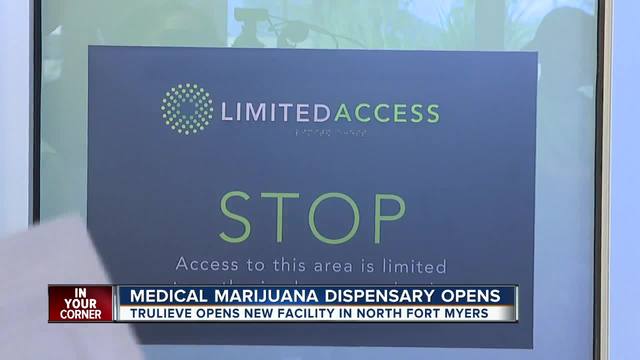
NORTH FORT MYERS, Fla. -- The first Medical Marijuana Dispensary in Southwest Florida is now open on Cleveland Avenue in North Fort Myers. Trulieve workers say the opening creates easier access to medication for patients suffering from anything from cancer to traumatic stress.
“It’s just an extra burden on the patients to pay an extra delivery fee,” said Victoria Walker, Trulieve Communications Director.
Walker explained patients have had to travel to other dispensaries around Florida ranging from Jacksonville to Tampa and down to Miami. For those unable to make the trip, they pay a delivery fee to have it brought to their homes. However, now that a neighborhood dispensary is available, patients can get one-on-one consultations and have a closer look at different types of medications available.
"There's plenty of patients, as you see, that are in need in this area. [I'm] hoping to see other MMTC's open in the area as well to give some competition and other products," said Medical Marijuana user, Jason Cole.
While Cole suffers from handling cancer, other patients say the marijuana helps will post-traumatic stress.
"My PTSD started when I was younger because my dad used to hit me," explained Jennifer Williams, Trulieve client.
Williams says that her PTSD, anxiety, and migraines are all calmed by the use of medical marijuana. She says it takes away the fear of harmful side effects some pharmacy drugs can cause.
“This is a great way for a lot of people to not be on pills that effects your liver… versus this actually helping you in other ways that isn’t effecting your organs.”
Inside the dispensary were shouts of joy from clients, but a couple doors down, some local business owners expressed their concerns.
One business owner said that they feel concerned the dispensary will bring the "wrong people" into the community and more addicts.
Nevertheless, others were in full support of the opening.
“Do you wanna go have Xanax and be addicted to that or medical marijuana?" said Samara, a local business manager. “Especially in our area and across the state people want to use it medicinally and I think it’s more that, than in the wrong way.”
For people looking to purchase medical marijuana, you will need an approved I.D. card from a physician or doctor. A list of physicians as well as dispensaries around Florida can be found at www.trulieve.com.

The Food and Drug Administration issued a strong warning on Tuesday against the use of an herbal opioid treatment called kratom, saying regulators have linked it to the deaths of 36 people who were exposed to the substance.
Kratom is an herbal supplement made from a plant native to Southeast Asia. It is primarily used to treat chronic pain, anxiety, and depression, as well as to relieve opioid addiction, the Washington Post reported.
In the U.S. it is sold in different forms, ranging from bags of raw kratom powder to energy drinks and tablets. It is available in different stores, including groceries and gas stations.
Opioids, which include prescription painkillers, contributed to the deaths of 33,000 users in the U.S. in 2015, according to data from the Centers for Disease Control and Prevention. President Donald Trump declared the opioid crisis a public health emergency in October in response to the epidemic. To provide a solution to the crisis, Indianapolis and 75 other cities and states have pursued a joint federal lawsuit against opioid manufacturers and distributors.
Due to the public opposition against opioid, people dependent on it for relief turn to kratom, a treatment that is heavily touted by its proponents as a safe and effective substitute for opioids.
However, as consumers’ dependence on the supplement increases and its availability becomes more widespread, FDA Commissioner Scott Gottlieb warned that kratom actually “has addictive qualities” and is believed to be “fueling new addictions.”
The FDA said in a statement that it is aware of 36 kratom-related deaths and is already taking measures to control the distribution and use of the substance. Although it is not classified as an opioid, its active ingredients produce opioid-like effects, such as euphoria. Since it is widely used as an opioid substitute, authorities are concerned that it might actually worsen the opioid crisis instead of curbing it.
Overseas, kratom is banned in 16 countries, including Thailand and Malaysia, where it originates, as well as Germany, Australia, and Sweden. In the United States, it is banned in Alabama, Wisconsin, Arkansas, Indiana, and Tennessee.
Supporters of kratom, however, claim that it is a safe alternative for opioids in treating certain conditions, such as chronic pain and anxiety, because it is a plant-based product. However, Gottlieb said there is no “reliable evidence” to support the effectiveness of kratom as a treatment for opioid dependency and that there are no other FDA-approved uses for the substance.
  Interestingly, a study conducted by researchers at Columbia University found that kratom contains an alkaloid named mitragynine. This alkaloid activates opioid receptors without triggering respiratory depression, HuffPostreports. This respiratory depression is an effect common to narcotic painkillers, which typically leads to a fatal overdose. Thus, the researchers concluded that it is still possible for drugmakers to develop safe kratom-based pain medications.
Because of the multiple claims about the positive effects of kratom, authorities are also not closing their doors on the probability of using kratom as a means to reduce opioid use.
“We also believe that if it does have therapeutic benefits, and it can be helping people, we want to see the science that can help prove that,” Gottlieb told CNBC’s Squawk Box.
For now, the FDA is conducting a formal scientific and medical evaluation of kratom in order to assess how the substance should be classified.